List of training courses
This list provides the titles for the most requested training course topics. Fuller details are available on request.
If the topic you want is not listed please contact me and I can discuss your requirements.
Most courses can be provided in a conventional format or virtual via Zoom etc.
A - Leading and managing people
A1 Stepping into management
A2 A manager’s first 100 days
A3 Coaching
A4 Mentoring
A5 Appraisals
A6 Mediation
A7 Consulting
A8 Absence Management
B - Organisational effectiveness
B1 Customer service
B2 Making effective decisions
B3 Accuracy – reducing errors at work
B4 Time Management
B5 Creative thinking
B6 Facilitation skills
B7 Root cause analysis
B8 Investigation skills
B9 Selling skills
B10 Negotiating skills
C - Working together
C1 Team working
C2 Emotional intelligence
C3 Continuous improvement
C4 Dealing with conflict
C5 Chairing or holding effective meetings
C6 Networking
C7 Assertiveness
D - Communication skills
D1 Influencing skills
D2 Presentation skills
D3 Holding difficult conversations
D4 Writing reports, letters, proposals, e-mails.
D5 Minutes for meetings.
D6 Eagle-eyed proof reading
D7 Effective reading
E - Becoming a confident trainer
E1 Developing engaging training programmes
E2 Designing effective training materials
E3 Magic of learning
E4 Personal training skills
E5 Designing and delivering Virtual training
The importance of participation
Room Layout
People need to feel involved from the first moment they walk into a training room. The way the furniture is laid out says what is going to happen.
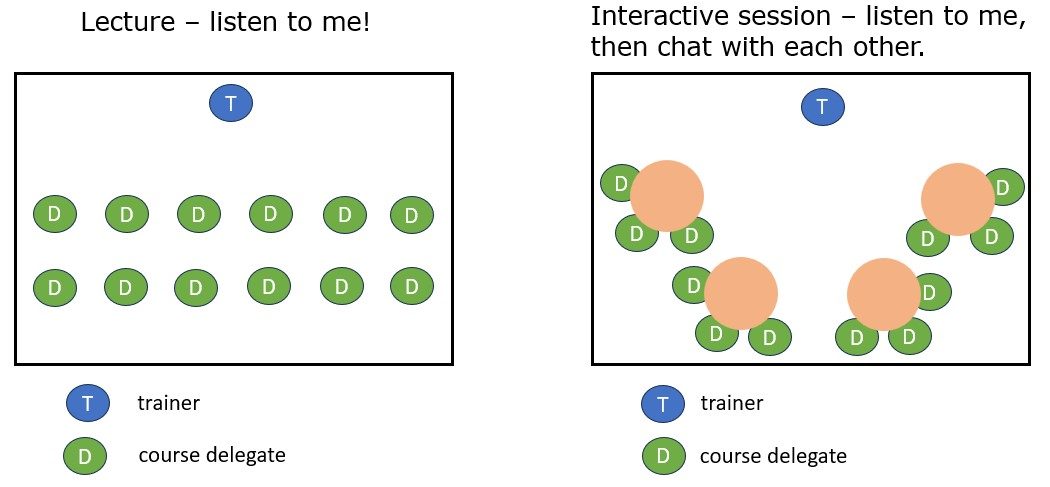
The café-style seating, with 3 or 4 delegates per table, allows for a much more engaging, and less threatening environment.
Also consider having gentle background music playing, to create a warm, natural environment.
Get delegates involved
* The trainer will open the session, sharing key ideas or principles, so everyone has the same level of understanding.
* Then invite delegates to chat at their tables to explore the opening ideas or theories.
* Then the trainer retakes control and invites views or opinions, before summarising and moving onto the next part of the session.
Why café style?
* Many people feel anxious about attending training sessions. They may have a bad experience on an earlier course, or may be naturally less confident or even shy.
* Sitting with two or three people at a separate table may encourage them to talk to their colleagues, and get to know them better.
* Using café-style layout also enables the trainer to make instant changes from sharing ideas or concepts with the group to having table discussions.
Group working
Make opportunities for delegates to work in small teams and collect ideas on specific topics, which you can then use later in the session.
* Give them time and space to work together and brainstorm ideas, which they capture on a flipchart.
* Then later throughout the course ask teams to share the ideas they came up with earlier.
Contact Me:
Tel: 07775 583493