1. By Sea, Land & Air
Introduction
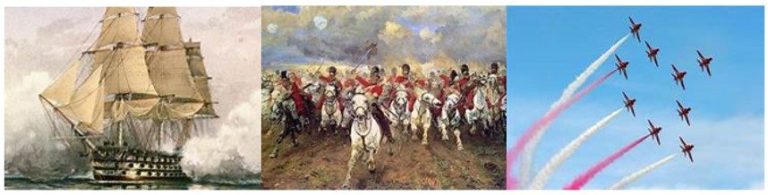
Britain has had three quite separate armed services for many years – the Navy to fight at sea, the Army to fight on land, and the Air Force to fight in the air. So it has long interested me why each of three services has had their own mini versions of the other two services.
What I will cover
I will explore the development of our armed services in a logical, chronological way. Starting with the formation of the Royal Navy, followed by the Army, and then the others as they were mustered.
The talk will not be a recital of bare military facts, but will take you through an unfolding history of our nation, and the threats we have had to confront at different times, and how our armed forces responded.
I will introduce gifted and visionary people who have sensed the need for a new development and had the energy, charismatic power, and connections to get things done.
What you will experience
Using creative graphics, photos, maps, and video clips, I will show you how this development took place, You will also watch some recently-recorded interviews with veterans from the Royal Marines, the Army, and the Royal Air Force Regiment outlining experiences outside what you would normally expect of someone wearing their cap badge.
So I will take you for a guided tour of our history and share with you how each of our three armed services have seen a threat, and then developed a novel solution. And be prepared for some surprises!
"Your excellent talk was very much appreciated by our members. Your presentation was clear and audible, especially as the hall has poor acoustics" J.
2. Airships

Introduction
It’s hard for us to imagine the impact that the first Zeppelins had. These huge silver, cigar-shaped aircraft, quietly purring along, at about 1000 feet above ground level, must have looked like something from another planet.
What I will cover
Graf von Zeppelin created the first airships which, when in 1914 the First World War erupted, became the first strategic bombers, and gave the German navy an inexpensive force-multiplier over the Royal Navy.
After 1918, Zeppelin was forced to share with the victors the many production and design secrets it had developed. Later Zeppelin was allowed to put into service two new, huge aircraft – the Graf Zeppelin and the Hindenburg. The Graf Zeppelin flew from 1928 to 1937. It offered the first commercial transatlantic passenger service, and made 590 flights, totalling almost 1.7 million kilometres. It had a crew of 36, and could carry 24 passengers.
The Graf Zeppelin was withdrawn from service after the Hindenburg disaster in 1937.
I will cover the brief histories of the British R100 and R101., and the two US Navy airships, U.S.S. Akron and U.S.S. Macon, which were huge flying aircraft carriers.
Airships today
The Zeppelin museum in Friedrichshafen has a complete full-size replica of the passenger and crew areas in the Graf Zeppelin. You can explore all the rooms and facilities passengers enjoyed, and so visualise what the journey was like.
You will watch the current Zeppelin NT flying from Friedrichshafen airport, cruising over the Bodensee at 2,500 feet, at 40 knots with the cabin windows open!
The future for airships
The future of airships includes design innovations, such as solar-powered and hybrid power. Modern airships can carry heavier loads further and cheaper than helicopters, with lower emissions.
"Hi Tony, I wanted to say how much I enjoyed your talk yesterday. It was informative, entertaining and engaging." H.
3. The Fall of Eben Emael
The end of the phoney war
Dawn on Friday 10 May 1940. The German army was about to attack neutral Belgium and Holland, and destroy the British and French armies. But they had to cross three bridges across the Albert canal, which could easily be destroyed by the Belgian fortress of Eben Emael.
The fortress of Eben Emael
This huge fortress had a garrison of nearly 1,000 Belgian soldiers, secure in an underground barracks, some 65 metres below the upper surface. It had taken 2,500 workers three years to construct.
It was protected by many concrete bunkers, equipped with anti-tank guns, machine guns, and searchlights. And on the roof of the fortress were huge concreate bunkers, with 75 mm and 120 mm guns, able to fire 360 degrees, up to a range of 17 kms.
What happened on the 10th May 1940?
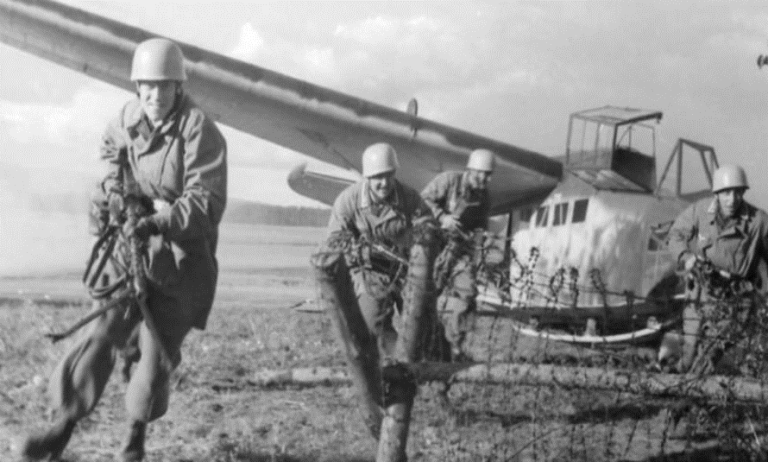
70 German combat engineers landed on the roof of the fortress in 10 DFS 230 gliders, which was the first secret weapon deployed that day. But then the engineers used the second secret weapon, and within 30 minutes the battle was effectively over. Most of the roof guns were disabled using shaped charge explosives, and the garrison of 1,00o Belgian soldiers were unable to dislodge the small force of German engineers.
What you will experience
I will show you what happened using video, animated graphics, and photos of the 1940s, and video and photos I took when I visited Eben Emael in 2024 and 2025.
The raid on Eben Emael motivated the allies to develop assault gliders of their own, and to create the Glider Pilot Regiment to fly them.
"Very interesting and enjoyable talk". B
4. The Glider Pilot Regiment
Introduction
In the dark days of 1940 Britain and the Commonwealth stood very much alone. Most of Europe was enslaved by the Nazis. The Prime Minister, Winston Churchill, was anxious that Britain should develop ways of striking at the enemy, and he ordered that 5,000 parachute troops should be recruited and trained.
It was quickly realised that developing a well trained parachute force alone would not be enough. Parachute troops, who are often landed well behind the front line, can carry limited amounts of heavy weapons and supplies. To be effective they would need to have weapons and logistical support landing with them. How could that be done?
What I will cover
I will start with a short background outlining how the airborne forces, both parachute and glider-borne, were developed in 1940. I will introduce the four main military gliders used by the Allies – from the small Hotspur used for training, to the massive tank-carrying Hamilcar. I will explain how the future pilots of the Glider Pilot Regiment were selected and trained.
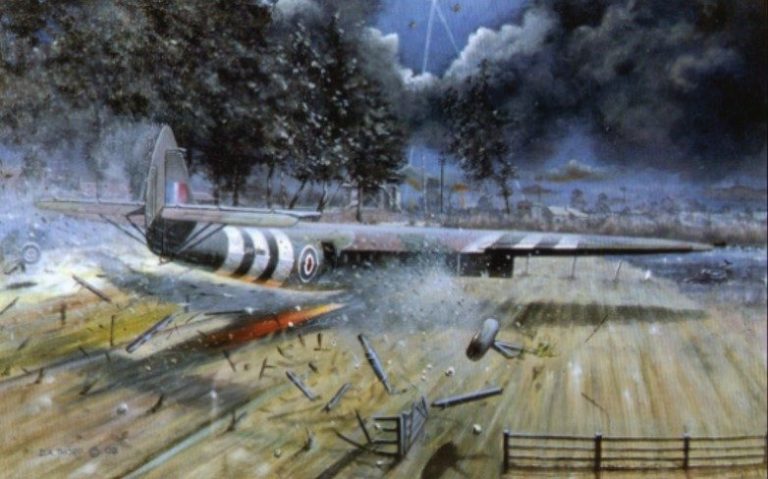
The session includes a realistic talk-down of what it was like to fly a Horsa glider into Normandy just after midnight on 6th June 1944, to seize the bridge over the Caen Canal at Benouville, later to be called Pegasus Bridge.
Throughout I link the overall story to the experiences of individual soldiers. You will see recently-recorded interviews with four of our veterans, as they tell you what it was like to fly these huge gliders into a live battlefield.
You will hear how the developing skills of the glider pilots were matched by the improved operational effectiveness of the Airborne Divisions, from the disappointing invasion of Sicily in July 1943, to the successful crossing of the Rhine in March 1945.
"We had feedback from our regulars that you were the best speaker we have ever had! - Jodie
"super talk.... the feedback from everyone who attended has been very, very positive" S.
5. Manna from Heaven
(the story of air resupply)
Introduction
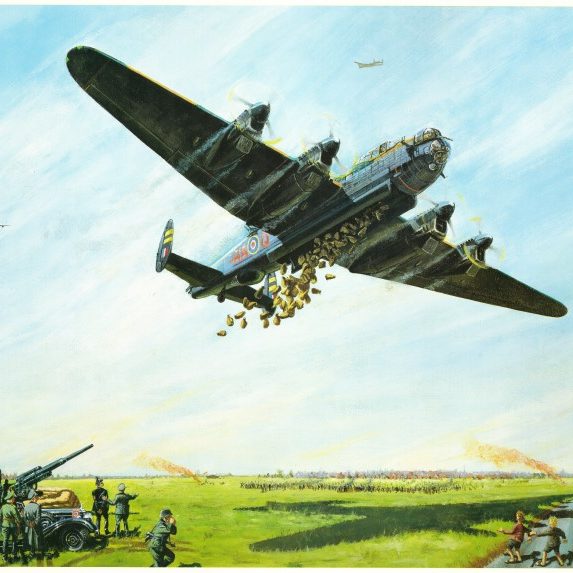
The advent of large-scale airborne forces in the 1940s spurred the development of air resupply on a scale never previously imagined. Sustaining a force of some 15,000 airborne soldiers many miles behind the front lines, so they are able to carry on fighting effectively, requires a huge amount of equipment, planning, and logistics.
With limited previous experience the British combined the best efforts of the boffins, the Royal Air Force, and the Army to quickly develop the equipment, the techniques, and the training to be able to sustain large airborne units in varied operational battlefields.
What I will cover
I explore the four phases of air resupply, from preparing the supplies and loading them in the aircraft, to landing successfully, ready for use, on the battlefield. I reveal the limitations imposed by the aircraft available at the time, and how changes in aircraft technology have dramatically improved the air resupply capability.
Not all air resupply situations are related to fighting, and I will explore how the resources and training can be adapted for different scenarios, ranging from the Soviet attempts to strangle Berlin in 1948, to relieving the humanitarian crisis in Ethiopia.
What you will experience
Using creative graphics, photos, and video clips, I show how this rapid development took place, and enabled airborne operations to contribute so successfully to victory. You will also watch some recently-recorded interviews with past and serving Air Despatch soldiers, and hear their experiences of working in this demanding and constantly-changing environment. You will also hear direct from the cockpit, with two retired RAF pilots sharing their stories.
"I enjoyed your talk today and will be recommending it." M.
6. How rotary winged flight has changed our world
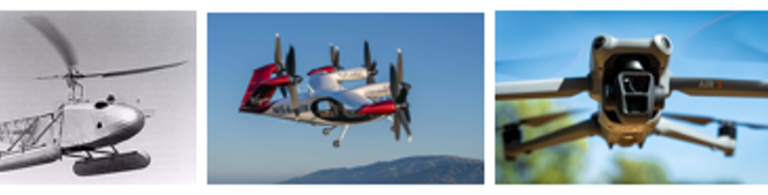
Introduction
Since the world began, people have watched birds in flight and wondered how they could emulate it. So I start with an overview of how we learned to soar like the birds, then converted this into hovering flight.
I will introduce you to the brave people who risked their lives to overcome the myriad of challenges they had to face. From the early autogyros to the initial flight of the Sikorski VS300 in September 1939, which set the standards for future helicopter design, but was he the first? Be ready for some surprises!
What I will cover
Using photos, animated graphics, and numerous video clips, you will see how the early prototypes developed into the wide variety of specialist machines we have today. The fast pace of development was inevitably driven by huge defence budgets, resulting from the never-ending series of World conflicts.
The military have seen a dramatic fall in the rate of battlefield deaths, and this has largely been driven by the use of helicopters for casualty evacuation. You will see how this developed from first helicopter usage in Korea, through to more recent conflicts in the Middle East.
Looking to the future
I will also include some of the many civilian applications we have today. Including some exciting electric aircraft – ranging from small taxis to multi seat commuter planes.
And of course – drones! Drones are having a far-reaching effect on warfare, and are re-writing the way future officers of all three services are being trained. Drones are also being used for so many different civilian uses, and we’ll look at some of them.
"very good talk with excellent graphics with history of pioneer helicopters from Russia and Germany I did not know about." D.C.
"A big thank you Tony most enjoyable and informative as are all your talks" R.
Contact Me:
Tel: 07775 583493